Project
1, Interactive Web Art & Culture
Andres Manniste February1, 2012
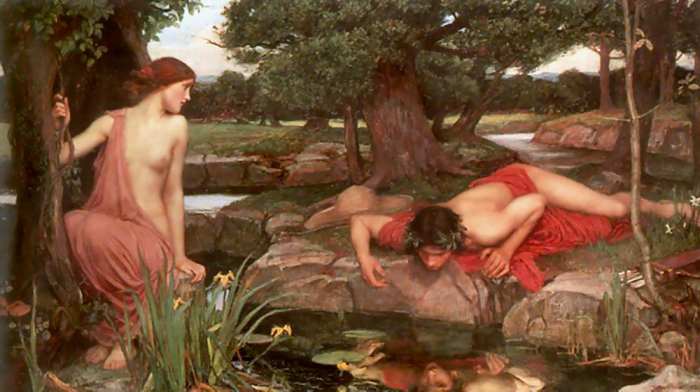
John William Waterhouse, Echo and Narcissus, 1903
Narcissus and Echo
"Ontological exploration is centred on physicality. The body and with it, aesthetics, is disruptive and transgressing of organised social systems. As such, art has the capacity to challenge order, reason and collective ideals."
One then witnesses an erotic scene between Narcissus and his double, all woven with impossible embraces, missed kisses, deluded contacts. With the eye, the mouth is the main organ of amorous longing, like the skin that is frustrated by a "thin film of water" that keeps them apart.
At last the moment of understanding is at hand. After many frustrations, Narcissus gathers that he is, actually, in a world of "signs": "You nod and beckon when I do, your lips, it seems, answer when I am talking though what you say I cannot hear." The exertion for deciphering leads him to knowledge, to self- knowledge. "He is myself! I feel it, I know myself now."
We have reached the crux of the drama: "What shall I do?... What I want is with me, my riches make me poor. If I could only escape from my own body!"
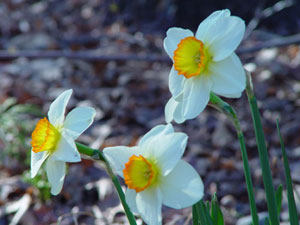
The tragedy reaches a higher level when Narcissus, at the moment when his tears disturb the pool, realizes not only that the loved image is his own, but furthermore that it can disappear -- as if he had thought that, for want of touching, he could nevertheless be satisfied with contemplation alone ("let me keep looking at you always"), which has henceforth also become impossible. In desperation he "beat his bare breast with hands as pale as marble"; and so Narcissus dies at the edge of his image and Ovid adds, "Even in Hell he found a pool to gaze in, watching his image in the Stygian waters;" When mourners, whose lamentations Echo repeats, prepare the funeral pile and seek his body, "they found nothing." Through a strange resurrection, the narcissus flower has taken his place.
Traditionally a self-portrait has been an Exploration of self. Kristeva points out that Narcissus is not surprised by his reflection as much as by the knowledge that this image allows him to know, for the first time, who he really was. With this came the realisation, that like the reflection, he too was an ephemeral image that could appear or disappear. Metamorphosis or his transformation into the metaphor of a flower completes his narrative.
Ontology is an understanding of the space that
our mind understands as existence. A self-portrait separates a subjective
being from an objective
self. The “picture” is not of me like a photograph
but rather a container for the me inside.
The computer interface offers an image as a mirrored reflection of
the world. It is, like in the story of Narcissus, ever changeable
and always true.
You are what you surf. Whom do you see when you look into the mirror?
Begin with yourself. Look at the image that your neurons create for
you and compare it with other images that you believe represent
you. From
this intimate reality, propose a self-portrait project.
The project
can be in the form of an image, a series of images or an animation.
You may use whatever materials you require together with the communications
technologies for this first project.