Andres Manniste
VISUAL LANGUAGE (2D), 510-112-DW FINE ARTS 1
Project3
Is technology moral?
Do you drive a car? Do you use your computer? Do you have
a cell phone? Do you think about the future?
|
|
"People have the misconception that teens care about what is going on in the world. However, that is far from true. I honestly do not want to care, but there are moments in my life where the anxiety that the world gives off creeps up and swallows me whole. I don’t want to care, but I have to care. This is my future that politicians and leaders have dangling by their fingers. Even though I just want to be this carefree teenager, the economy, politics, and the rest of the world won’t let me. " - a teenager
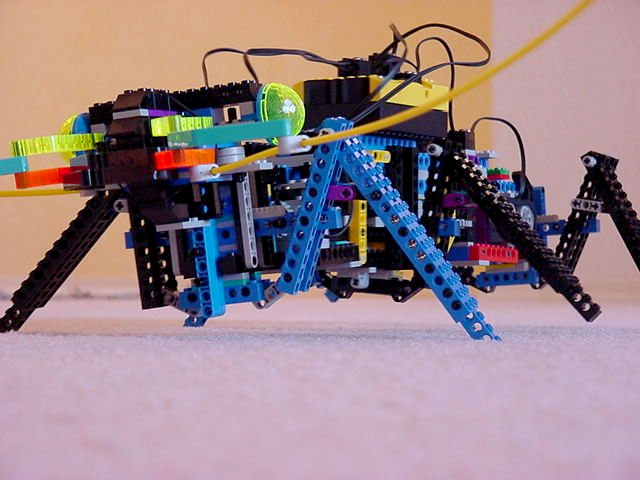
The dream of robotics is, first, that intelligent machines can do our work
for us, allowing us lives of leisure, restoring us to Eden. Yet in his history
of such ideas, Darwin Among the Machines, George Dyson warns: "In the
game of life and evolution there are three players at the table: human beings,
nature, and machines. I am firmly on the side of nature. But nature, I suspect,
is on the side of the machines." As we have seen ... believing
we may well not survive the encounter with the superior robot species.
How soon could such an intelligent robot be built? The coming advances in
computing power seem to make it possible by 2030. And once an intelligent
robot exists,
it is only a small step to a robot species - to an intelligent robot that
can make evolved copies of itself.
From Bill Joy (2000) Why the future doesn't need
us
The access to information through the freedom of selection provided by technology
is a challenge to social institutions. You are living in a time where you
may communicate with other individuals in any language, from any culture,
anywhere
at anytime. When surfing the internet you might be exposed to a webpage
soliciting pornography, an article on philosophy, a page discussing the
latest sports
scores, or a site designed for your immediate family. None of these sites
are presented to you more or less importantly on a seventeen inch screen.
What of value systems in such a world? Who decides? Who filters? The very
societal structures, including political beliefs, religious upbringing,
economic controls
and cultural capitals that were necessitated by centralised culture are
being challenged by information technologies. Villains have as much access
as the
good guys do.
It is nevertheless critical that this universal and unfiltered knowledge
be available to you as a responsible person living in post-industrial
times. For
these reasons, understanding morals and ethics are an increasingly
important consideration at all levels. School is a defining component of
culture
that works with you to construct personally useful values for you and
society. Because of information technology, the school is already a
place for the
production
of knowledge. (Lyotard, 1979)
Is technology moral? Is technology ethical?
For project three, develop your ideas and opinions on the morality and ethics of technology and create a project that expresses these ideas.
1) Form a GROUP of at least two students.
2) DEVELOP an idea chart that generates a proposal
for an integrated and unified visual document which expresses a viewpoint on
the morality and ethics of technology.
3) Develop a WRITTEN proposal, a story board and
preliminary work for a final project.
4) PRODUCE a final project. It might be formal
(as in basic design or artistic), narrative, symbolic, conceptual (but documented)
or practical (as in an advertisement, website or portfolio)
INTERACTIVITY and MOVEMENT (literal
or metaphoric) is a must in this project.
YOU MAY: use the new mediatechnologies
(Computers, Photographs, Film etc.)
THE PROJECT CAN BE : a film, a
webpage, a series of digital printouts, a
game.
YOU MAY: use traditional internet, animation, film or ww2 (youtube, facebook, on line drawing and painting tools, virtual worlds etc.)
YOU MUST: have a concrete document.
PLANNING and PROOF of
PROCESS (concrete evidence) will generate a higher grade.